I’m not a marathon runner. In fact I don’t really even think I’m that much of an athlete. However I have suffered from chronic exertional compartment syndrome and have since had surgery to correct it. I thought I’d write about my experience here in the hopes that someone might find it useful.
A Little Bit of History
I was very active, mostly with a lot of squash, premier netball, as well as the odd game of touch rugby. I had had a tightening of what I thought were the muscles on the outside of my legs for some time and had asked various people if they knew how to stretch them. I’m fairly au fait with anatomy after studying it at school but even I couldn’t figure it out. They’d been uncomfortable mostly while I was playing netball, but I put it down to not being as fit as I could be and put up with the pain.
It wasn’t until one day I was playing squash when the pain got so bad I had to come off the court. Luckily the manager of the team I was training with happened to be a physiotherapist and mentioned that the symptoms I was describing sounded like compartment syndrome. I was training for squash nationals and playing finals netball so I didn’t want to stop. I’m also fairly stubborn when it comes to pain stopping me doing things (says the girl who walked home one day with two badly sprained ankles!) so I didn’t treat this any differently.
With squash nationals done and dusted, I moved away from the city where I first heard about compartment syndrome a few months later but began to research it online. It wasn’t until one day I left the squash court and ended up on the floor in tears from the pain that I knew I had to do something about it.
What causes the pain?
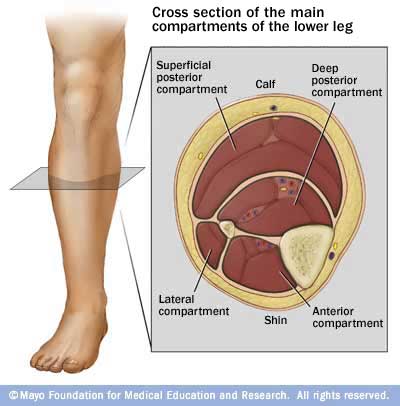
When we exercise, the body pumps blood to the muscles that are being worked, causing the muscles to swell or expand. The muscles are contained within a sheath. You know when you buy meat from the supermarket and it sometimes has that clear, stretchy stuff on it? That clear covering is the sheath. When people with compartment syndrome exercise, there’s not enough room within the sheath for the expanding muscle, therefore pressure builds and pain arises. A friend of mine once used a great analogy – it’s like trying to blow a balloon (muscle) up inside a drink bottle (sheath). It just doesn’t work.
Doing Something About it
I went to my GP who referred me to a specialist sports practitioner, who then referred me to a surgeon who specialised in compartment syndrome. Said surgeon sent me for tests (which, by the way, aren’t covered by ACC as the ‘injury’ is deemed to be progressive – kind of like RSI which, incidentally, IS covered).
Honestly, if there were a best part about having CECS, it would have to be seeing a medical practitioner about this condition and watching their eyes light up when you tell them what you have. It’s not a common condition and I think they get a little bit excited when they get to deal with something different from the norm. I digress!
By the time I got the appointment for pressure tests, I had developed drop-foot (or foot-drop as it’s otherwise known) which is when your foot makes a distinctive “slapping” sound as you walk because you can’t lift the front of your foot properly. I couldn’t walk more than 100 metres without the pain getting so bad I’d have to stop. Ten minutes after ceasing exercise, I was fine – which was probably the single most frustrating thing about the entire condition.
The Pressure Tests
I will not lie. The tests are not pleasant. Basically I had three injections of anaesthetic (in marked spots) into each leg to numb the areas for when the BIG needle gets inserted. I was then told to do an activity that causes the pain and come back to the room once it comes on. The specialist was surprised that I was back within five minutes, even though I’d continued as long as I possibly could because I wanted to be sure I got the results I knew would come.

The second round of injections measure the pressure inside the compartments of your leg. Anything over 30mmHg is “surgery territory”. As a gauge, my worst compartment was ~90mmHg. No wonder I was in so much pain!
As a result of the pressure tests, it was recommended that I be prioritised for surgery and I was placed on a waiting list. Through a mix of medical misadventure and me moving city again (and therefore District Health Board jurisdiction) it took me a further 8 months before I finally got my surgery. Bearing in mind that this was around two years after I had initially consulted my GP, I was virtually unable to walk and had put on a lot of weight – a horrible side affect for someone who used to be so active.
Finally! The Surgery
The technical name for the surgery I had was bilateral tricompartmental fasciotomies, which loosely translates to having three compartments in each leg released. When I say released… they make an incision, then cut open the sheath that holds the muscle in place. It basically allows the muscle to expand as large as it needs to when you’re exercising.
It was an overnight stay in Middlemore Hospital for me (and I’m thankful it was only one night!). When it was time to go home, I actually managed to stand up with my legs supporting my full weight while I got dressed. The only piece of advice I can give you is DON’T DO THIS. You may think you won’t move, but you will and it hurts! I was in a wheelchair to start of with, but given crutches before I left the hospital.
Healing Time
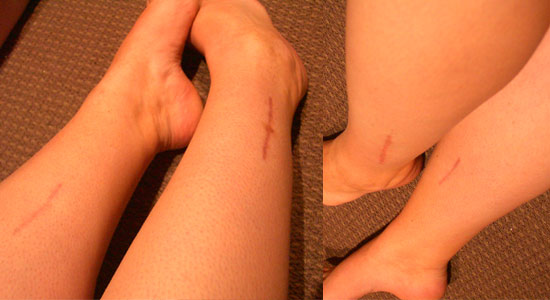
I have two scars on each leg – one on the outside above my ankle bone about four inches long and one on the inside of my leg toward the front about midway up my lower leg – about three inches long.
The advice I had read and was given was that it should be around 12 weeks until I could get 100% back into sport. This wasn’t the case for me, however. I went back to work two weeks after surgery (I recommend taking longer – perhaps another week) and even though I held a sedentary position, my ankles and feet would swell up enormously after keeping them “down” for the day, even though I had tried to elevate them as much as I could.
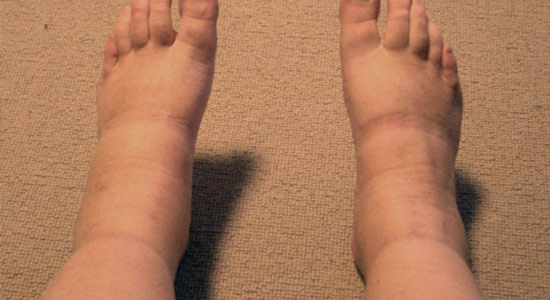
My employer at the time was less than supportive, even though I’d requested that I work from home. If you can, I would definitely aim for three weeks to recover. I was walking without crutches after one week but would still get pain and swelling in the week following. My recovery wasn’t aided by a minor infection in one of the wounds either, so I now have a more prominent scar than I would have otherwise.
Getting back into the Swing of Sport
So, after my two years of not being able to do anything, I was finally free to get back into sport! Unfortunately for me, I don’t think my body was as keen as my mind was and I was bogged down with miscellaneous injuries over the coming year (including prolapsed discs in my back and strained calf muscles). It’s now been around 15 months since I had the surgery and I’m finally uninjured enough to get back on the exercise wagon – enough to hopefully start losing some of the 20kg I packed on over the time I was involuntarily inactive.
Even when running now, I get numbness in my toes and feet. Areas of my leg, ankle and foot are still numb due to the nerves being severed during surgery but I’m hoping to get most of that feeling back. I still get some fatigue and soreness in the same areas as before but nowhere near the amount of agony I was in pre-surgery. My legs are also a funny “shape” because the muscles bulge out in places they didn’t bulge before, but it’s purely aesthetic and I knew to expect that. They are though, still a lot more svelt and “spongey” to the touch than they were pre-surgery. My poor legs.. what an ordeal!
Further Information
If you have any questions, you can contact me or leave a comment on this post.
Here are some websites I found useful:
MayoClinic – Chronic exertional compartment syndrome (Highly Recommended)
Wikipedia – Chronic Compartment Syndrome
EDIT: I have now also created a Facebook page. See https://www.facebook.com/compartmentsyndrome/
277 replies on “Life After Compartment Syndrome”
Thanks for the great article – I’m also in NZ, saw a sports doctor a few years back and found out the hard way that ACC does not cover.
If I do pay for pre appointments etc, do you know whether the surgery cost will be covered if I go on a public waiting list or is this just a private surgery regardless?
Hi Jess. The surgery cost was covered for me under the public system. It was >10 years ago now so things might have changed but I hope you get your surgery soon!
Thanks, everyone, for sharing your stories! I am 3 weeks and 3 days post-op, bilateral fasciotomy to release all four compartments in each leg.
I developed chronic exertional compartment syndrome in 2013 while training for my first half marathon. I’m by no means fast, but I love to run! At first I thought maybe it was just shin splints, or over-doing it, but it increasingly got worse over time, usually starting up around the 1/4 mile mark. Some runs felt okay…one was so bad I turned and walked back after about 1/4 mile and had to sit in my car for awhile before I could even drive away, the foot drop was so bad.
I was 28 when it started, and I’m a nurse, so I eventually had a suspicion as to what may be happening. It took 3 years to get diagnosed. The first doc told me to try some shoe inserts. $60 later, no change. The second doc said he thought this was out of his scope and he wanted me to see a neurologist (at least he was honest). It was 2 months before they could get me in to see neuro, and in the meantime I tried chiropractic measures. A buddy of mine is a (excellent) chiropractor nearby, and did manual adhesion removal (MAR), which seemed to help. Because of this success I cancelled my appt with the neurologist. Soon after stopping at the chiropractor, things continued to progress as before. The 3rd orthopedic doc I went to finally recognized what was likely happening, and referred me to a specialist at nearby University of Iowa Hospitals, where pressure testing confirmed CECS.
After reading your stories, I’d say I’ve been blessed to have a smooth, and near painless, recovery so far. I was up walking with crutches the day of surgery, and used them for a few days, not quite a week. Honestly I used the crutches more to steady myself, as the gabapentin they put me on made me dizzy. Lots of ice, elevating (in my recliner, with two pillows under my legs), and tylenol. By day 7, I was walking around the house sans crutches. It was beautiful that day, and I spent most of it with a book on my back deck! After the 2nd week I’ve barely needed to take anything for pain.
I haven’t gone back to work yet, and have been loving the “time off” to work on projects and things around the house. Both legs, but especially the right, are still quite numb around the incisions, and I can tell when I crouch down there’s a bit of swelling. As of now, I’m just excited to get the go-ahead to try running, as well as anxious to see how scarring ends up. If anyone has tips/tricks/advice that has worked to prevent scarring, I’d love to hear (:
Amanda-springer@hotmail.com
Amanda
I had bilateral fasciotomy on Oct 5th. So it has been just over 4 weeks. One leg healed great. I could probably run on it today if my other leg didn’t hurt so much. Anyways, my left leg got a minor infection. It took 2 weeks to heal and only once it healed is my leg starting to feel better. Most of my pain is near my ankle bone, feels like tendon or muscle is really really tight.It also itches pretty bad. Is this common? I can’t recall that my right leg had this pain. I was hoping to have been pain free by now. Im still limping a bit in my left leg.
I have this exact same problem with the pain around my left ankle. Have you found any relief?
Another vote for the same ankle pain in only my left ankle after having surgery for both legs. I am 3 weeks post op and would love some follow up on this. I hope all went well. I was a half marathon runner, avid outdoorsman, martial artists, before being halted by this almost a year ago. The last year has been a dark road of depression due to not being able to do the things that bring me joy. Any insight on how/if this was resolved would be very appreciated. Thanks!
I just had the surgery a little over a week ago, I have pain in the left ankle as well. I had 2 Compartments released, even though all 4 were elevated, my doctor said he saw no difference in releasing 4 compared to 2. I was able to walk the day of surgery with no crutches but had to hold onto something. I now able to walk fine however after getting up from lying down I get terrible pain, it goes away but the pain is severe. And like the others, most of the pain is in my left ankle.
I have the same ankle problem. I called the Dr and they said that with the release they have to cut through some of the muscles where the fascia attached and that point is near the ankle so it’s totally normal.
This is a great blog I had compartment syndrome after being unconscious for a few hours I didn’t have insurance so I didn’t want to go to hospital until I couldn’t take the pain any longer I was in the hospital for 36 days the surgeon had to remove all the muscles and tendons on the outside of my entire lower leg my kidneys failed and was on dialysis for two weeks until they improved enough to heal on there own it has been 8 months since my 7 surgeries and I can not move my foot or wiggle my toes anymore I have constant leg pain and sever pain in my foot and toes I can put weight on my leg just not all of my weight I am having trouble doing therapy because the muscles and tendons are no longer there to get better I was told by the doctors it might be as good as it’s gonna get I have a permanent full lower leg prosthetic that is basically a boot to lift my foot so I don’t trip on it and give me extra support has anyone had similar muscle and tendons removed and what happened did it get better over time or was it crapy permanently I am unable to walk very long and even sitting hurts after a period of time any advice would be appreciated hope everyone recovers fully and gets better
I had acute compartment syndrome in my left forearm. I don’t remember anything. I don’t even know what happened. Lost all muscle in the forearm n lost use of hand n fingers. I’m always in pain from the nerves I assume because it’s always a burning feeling. It’s been almost 2 years and I’m still suffering with pain
I had a fasciotomy surgery on my right arm was in the hospital for 5 months…I’m a recovering drug addict I lost full function in my arm an hand and fingers my hand is stuck in a position that looks like I’m making an “E” in sign language…I am 28 years old an need some advice on what to do ..my surgery was in June of 2016 ..my name is Heather I would be blessed if I could get some more information about this here is my email address alltherimeuniquebabii7373@gmail.com ….I have trouble with everything I burn myself all the time it’s such a relief to know I’m not alone in this …thank u for ur time …
4 Weeks out – Working again chasing bad guys
8 weeks out – back to full ruthless exercise no issues.
3 of 4 done on each leg.
I had compartment surgery on my left leg in November 2015 and due to complications that the doctor did not foresee, I am allergice to disposable stiches, I had an open wound for six months before he would even consider sending me to a wound specialist. I took in on myself to go and they had to wound closed within two months. I have not gone back to that doctor even though I need the right leg done. It was not as bad as the other. I dread going back in. I have started going back to the gym however, I cannot seem to find good treadmill sneakers and by the time I reach 30 minutes, my legs start to hurt and I have to stop for a few moments before starting again. If anyone knows of any, I usually wear something that has memory foam in them, I would greatly appreciate it. Thanks.
Actually, memory foam is not the best support for your feet because it does not give your feet the good solid support that they need. I usaly wear Nike’s and they have been the best as far as support, they have lasted me all track season without any problems, I would suggest that you try something like that.
My husband had compartment syndrome operation on his calf monday had his second operation Friday to stitch it back up. Came home Saturday and now his foot is numb.. is this normal?
Has anyone had a fasciotomy due to developing Compartment Syndrome in your thigh?
I had a total hip replacement in 2013. 1 week after the surgery, i was awoken with the most excruciating pain i had ever felt and noticed my leg was swollen nearly double in size. I couldn’t even walk to get in a car to be brought to the hospital. I had to be transported by an ambulance.
After running test it was found that I had a blood clot in my leg and that possibly caused my compartment syndrome. I had a fasciotomy and stayed in the hospital for about 3 weeks. After 67 staples from above my knee to the side of buttocks and some physical therapy to basically teach me how to walk again, I was discharged.
I went to month of physical therapy.
I still have numbness around my knee and tingling in my toes. I cannot lift my leg while in a sitting position, I cannot raise my leg high enough to put my pants on. If I walk too much my thigh hurts and if I sit too long and decide to get up and put weight on my leg I get a sharp pain in the center of my thigh along with pain running down the inside of my leg from the groin area to about the middle of my thigh. I also have back problems due to walking different to avoid pain.
I visit a neurologist and an orthopedic specialist. Both are scratching their heads.
I’m just curious to see if anyone has been through or is going through the same and if so, what do you hear and how do you function?
I just had the surgery, Suregeon said four week recovery, Four compartments on Both legs. (I think 4 but I only have one inside incision)
I only measured about a 35 however my calves would fail to work after 1 minute of hopping. I also could run for about 1KM before pain set in however I would have shin splints and extreme knots and tightness for weeks afterwards. I passed all my running training to get into my job which was very hard running 2.4k 8 different days.
Best remedy for me was Saunas and stretching in the sauna w/ massage.
Day one – Hospital overnight with drains. Morphine/Severadol/Ibprofen/Panadol
Day Two – Four Don’t remember because of pain killers.
Day Five – Crutching fine Brufen
Day six – Bad blood rushing pain in left leg when first standing. (trick is to sit on edge of bed and let blood slowly pool into leg) – UN-bearable pain when standing would take 15 minutes to warm left leg up enough to crutch on it as it was super tight and did not want to sit flat on ground. I was dumb and went to the mall and crunched around that day. Tramadol/Brufen/Panadol/ice/compression socks
Day Seven – Payback from yesterday (Elevated whole day) Brufen/ice/compression socks
Day Eight – Still resting unable to walk on left leg, right is fine.Brufen Panadol Ice/Compression Socks
Day Nine (Today) – warmed up leg and able to stretch it and walk on it without crutches for a few minutes. Brufen/Ice/Compression Socks
Day Ten – See surgeon.
Pretty bored. Reading all the comments helps. Compartment syndrome sucks but as much as it sucks you have to think there are people that would kill to have it over their cancer/no legs/paraplegia ect.
has anyone who has had the surgery have the pain return?
Hi JP,
My fiance has the same compartment syndrome and about a year ago had the same fasciotomy surgery. Unfortunately, the pain did return and to this day he still comes home from work everyday after minimal time on his feet complaining about his legs. We are desperately trying to find solutions and answers to help overcome his pain. If you or anyone else has advice or has experience in with this situation please contact me. This is a very uncommon diagnosis with very little knowledge.
Thankyou!
Hi there, your fiancé is not alone! I had all eight calf compartments operated on in 2001 and still have pain all the time. I wear compression stockings and it helps. Your fiancé may want to try that. I wish I knew why we continue to have pain. 🙁
– Rachael
I tell doctors the pain is still there and they look at me like I’m an alien. They say you’ve had the surgery it can’t come back. My legs disagree. It’s been a long time too and I’m in pain and sedentary because it hurts so much. I am not sure if I had all the compartments done but I’m sure I had upper and lower on both legs. I’m pretty sure it was all 8 as the pressure was 70 in one leg and 65 in another? Mine was outpatient although it took me a bit to wake up from the anesthesia which scared them. I healed quickly but as soon as my stitches came out I was clumsy and popped an incision which had to heal from the inside out. It was not fun sticking tiny gauze up into my calf twice a day for months. I work in a large building and by the time I walk to the exit and right across the street to my car my legs are burning. Compression socks are a good idea because weirdly I wore them on a plane and my mom did and she hated them but I thought they felt good. Maybe that’s why.
How much does it help Rachael?
Im getting told its nerve pain and to take amitriptyline though im on co-codomol too and it doesnt help but it might help you, pain is so bad sometimes i just jump into bed and try sleep it out. I thought i was the only person because they said the surgery it almost 99.9% success rate with no complications😴
I had my surgery in 2007 and now 10 years later it’s completely returned. Mine is hereditary because it is symptomatic in my niece and she said something about my brother (her dad) I have gained a lot of weight but after the surgery things were so much better for a little while and then everything came back and is hurting again. Someone said something about scar tissue? All I know is I’ve put on weight and I have no clue how to get it off considering I’ve gotten older my metabolism has slowed and it hurts horribly to exercise. I was hoping to have weight loss surgery to relieve the pressure, but due to stupid reasons I was denied but may still have a chance at it. I’m hoping that will help a lot but I still have horrible symptoms and they hurt so bad. I have four scars on my calves in the upper and lower parts on the outside. One was super fun because I popped my incision as soon as the stitches came out. I’m so frustrated and nothing is seeming to help so my father is the one who has it and he also gave me the propensity for diabetes, heart disease, etc. things I could avoid if I could exercise which I love so much. It’s so hard to deal with when you are sedentary because of it. If you find any info please let me know.
Hi JP,
I had the surgery last year and have had pain on and off but lately it is to the point of almost not walking. I am getting swelling around my lower legs/ankles and constantly feel tightness in the upper part of my legs. I had them tested before surgery and was 72 mm-Hg. They only tested the front of my legs and released 2 compartments. I then went back last week and got them to test again as I have had alot of pain lately. They tested only one of the compartments that ended up being 28 mm-Hg. I was curious as to why your scars are so low on your leg as that is where I am getting quite a bit of pain but mostly under my knees on the outsider of my legs where I had surgery. If you could give me any advice it would be greatly appreciated.
Yes ,i have , the surgery was completely unsuccessful